

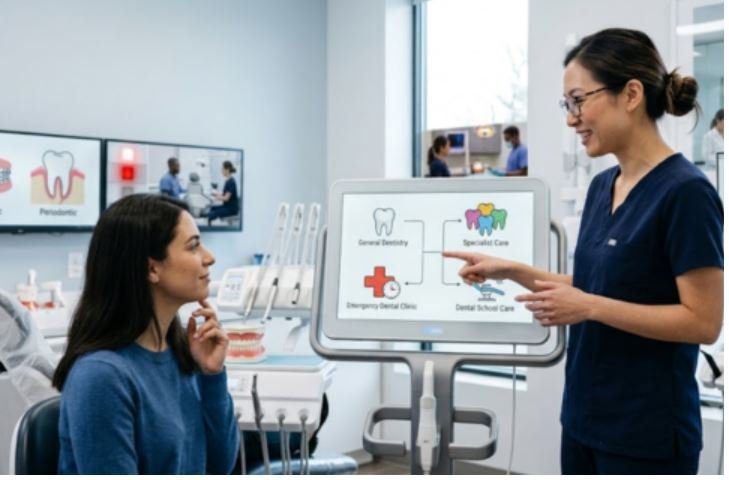
When you need dental care, you have multiple options available. Deciding where to seek treatment depends on understanding what different providers offer, their strengths and limitations, and how your specific situation aligns with available options. Making an informed choice means getting appropriate care at a reasonable cost.
General Dentistry: Your Primary Care Foundation
Most dental care originates with a general dentist—your primary dental care provider. General dentists handle routine cleanings, cavity treatment, basic restorations, and many cosmetic procedures. They also identify when specialized care is needed and refer appropriately.
The advantage of establishing care with a general dentist is continuity. They understand your full dental history, your specific risk factors, and your preferences. Over time, they develop a comprehensive picture of your oral health that informs all future care recommendations.
Dental Specialists: Focused Expertise
Specialized dentists (periodontists for gum disease, endodontists for root canals, prosthodontists for complex restorations, orthodontists for alignment) offer advanced training in specific areas. When your situation requires specialized expertise, seeing a specialist often produces superior outcomes.
However, specialist care is typically more expensive than general dentistry. Additionally, seeing a specialist without a referred general dentist means you lack continuity of care.
Urgent Care and Emergency Clinics
Dedicated emergency dental clinics provide rapid assessment and treatment of acute problems. They’re useful when traditional practices aren’t available, but they typically focus on emergency management rather than comprehensive care.
After emergency treatment, you still need follow-up care from a general dentist. Emergency clinics are designed for crises, not ongoing care.
Dental Schools and Reduced-Cost Options
Dental schools offer treatment at significantly reduced costs because students perform procedures under faculty supervision. If budget constraints prevent accessing traditional dental care, dental schools are valuable resources.
However, treatment takes longer because students work carefully under supervision. Complex cases might not be appropriate for student treatment. Care quality varies depending on student experience level.
Hospital Dental Departments
Hospitals with dental departments typically manage severe dental trauma, complex cases requiring anesthesia, or patients with significant medical complications. For routine care, hospital dentistry isn’t appropriate or accessible.
Teledentistry and Virtual Consultations
Some dental issues can receive initial assessment through virtual consultations. This option is useful for minor questions, follow-up consultations, or situations where in-person assessment must be scheduled. However, true dental diagnosis and treatment require hands-on examination.
Evaluating Your Specific Situation
Choosing appropriate care depends on your situation. Emergency involving severe pain, swelling, or trauma? Seek immediate care at an emergency clinic or hospital if necessary.
Routine preventive care or minor treatment? A general dentist handles this effectively and cost-efficiently.
Complex restorative or specialist care? Working with your general dentist who refers to appropriate specialists provides coordinated, comprehensive care.
Long-term care involving multiple procedures? Establishing care with a general dentist you trust provides continuity and efficiency.
Cost limitations preventing traditional care? Dental schools offer reduced-cost alternatives, though treatment takes longer.
Cost Considerations
Dental costs vary significantly based on provider type and treatment complexity. General dentists typically cost less than specialists. Dental schools cost less than private practices. Emergency clinics may charge premium rates for immediate availability.
Understand costs upfront before committing to treatment. Ask for estimates and understand what your insurance covers.
Location and Accessibility
Proximity to your home or workplace matters practically. Emergency care is less accessible if your only option is 45 minutes away. Established care relationships are harder to maintain if the dentist is inconveniently located.
However, don’t sacrifice care quality purely for convenience. If a superior provider is worth traveling to, that’s often worthwhile.
Coordinated Care Benefits
Using one general dentist in Fort Worth, TX, who coordinates with specialists when needed provides significant advantages. Your primary dentist maintains your complete history, understands your preferences, and ensures all providers communicate.
This coordinated approach prevents duplicated testing, ensures consistency in treatment philosophy, and typically reduces overall costs by avoiding unnecessary procedures.
Insurance Considerations
Verify which dentists and specialists are in-network for your insurance. Out-of-network providers cost significantly more. Understanding your coverage—what’s included, what requires higher copays, what needs pre-authorization—informs your choice.
Your insurance might cover general dentistry at a higher percentage than specialist care or cosmetic procedures. This affects your out-of-pocket costs for different treatment types.
Communication and Comfort
Beyond credentials and cost, how a provider communicates with you matters significantly. Do they explain their recommendations? Do they discuss your preferences? Do they respect your input? Do they make you feel comfortable and supported?
The most technically qualified provider who doesn’t communicate well might leave you confused and anxious. A competent provider who communicates clearly and respectfully supports better outcomes.
Building Your Dental Care Team
Optimal dental care typically involves one trusted general dentist who coordinates with specialists when necessary. This approach provides continuity, efficiency, and comprehensive care.
Take time finding a general dentist you’re comfortable with and who listens to your concerns. Once established, that relationship becomes the foundation for all your dental care.
