

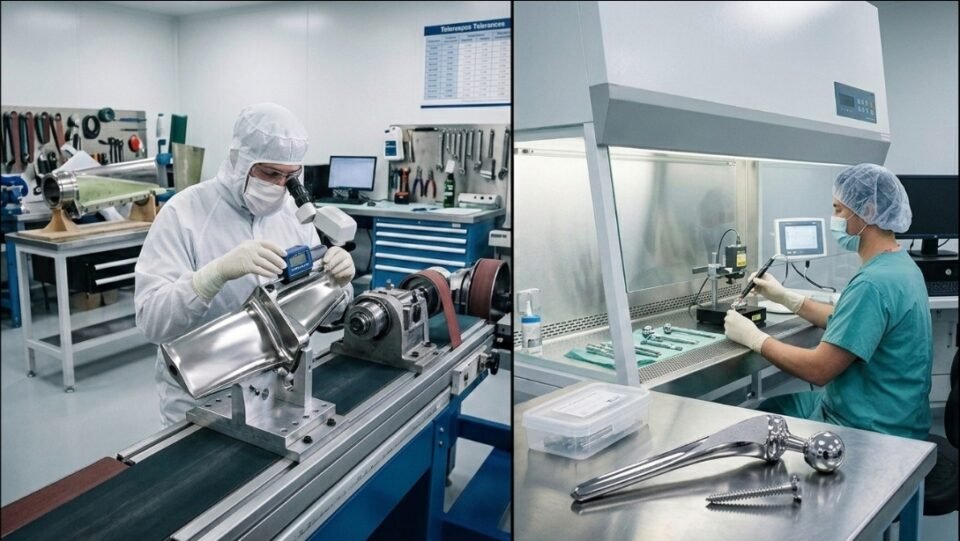
Most manufacturers know that the quality of a finished part is pretty important. But what makes the Aerospace and Medical industries different isn’t that understanding – it’s the stakes when it all goes wrong. A small burr left on a surgical instrument can be a breeding ground for bacteria and cause patient harm. A tiny surface imperfection on a turbine blade can be the perfect starting point for a fatigue crack when the thing is under maximum stress. In these industries, surface finishing isnt just the final step in production – it’s a mission-critical process that needs to be handled with the utmost care.
So, what exactly do these industries do differently – and what can other manufacturers learn from their approach? The answer starts with getting a handle on how industrial milling media and finishing processes are selected, validated and controlled – to a level that most general manufacturing operations will never need to reach.
Why Using the Right Tumbling Media is Just the First Step
For most manufacturers, the goal of finishing is pretty simple: get rid of the burrs, clean the surface and get the part ready to move on to the next step. The choice of tumbling media is mostly driven by what works, and what fits the budget. If it’s close enough, it passes the test.
Not so in Aerospace and Medical manufacturing. “Close enough” is just not an option. Surface finish is measured and documented to a very precise specification – often with Ra values (average surface roughness) that have to fall within a specific range, not just below a certain threshold. For structural Aerospace components, Ra values of 0.8 microns or below are pretty common. For Orthopedic implants and surgical tools, the requirements go even further – sometimes down to Ra values of under 0.1 microns.
You dont get that level of precision by accident. It starts with choosing the right tumbling media for the specific job, and it doesn’t stop there. Every stage of the process – media type, machine settings, cycle time, compound chemistry and post-process inspection – has to be documented, validated and controlled. And when something changes in the process, it goes through revalidation before production even thinks about getting back underway.
How the Way You Choose Grinding Media Matters in High-Stakes Applications
When it comes to aerospace and medical manufacturing – particularly in high-stakes setting – surface prep often begins well before a part ever reaches a finish machine. The way a part is machined – what tools get used, how aggressively it’s run, the condition it leaves behind – all these things leave their mark on the surface. And the finishing process has to work with what’s been left behind.
So in these industries, choosing your grinding media – that’s not just an afterthought, but a key part of a much bigger process chain. The media has to take account of what’s come before – the machining process – and deliver a surface that meets the needs of whatever comes next. That might mean hitting a specific Ra value, getting a smooth edge to a precise tolerance, or just making sure the surface is free from any contamination that might mess with biocompatibility.
In medical apps especially, the grinding media you choose has got to take into account stuff that most operations don’t even think about – material compatibility. Materials like titanium and cobalt-chrome alloys – often used in orthopedic implants – can be super sensitive to contamination from iron-bearing media. If you introduce even tiny amounts of the wrong stuff in a biomedical surface, it can make the whole part unsuitable for use in the human body – that’s not just a hypothetical problem, it’s a very real risk that drives media selection.
Why Stainless Steel Tumbling Media Wins in Tightly Regulated Industries
When surface finish requirements go from being useful to being crucial – like when you’re polishing surgical instruments, burnishing implant components or finishing aircraft parts that will be working in extreme conditions – the media selection conversation changes pretty drastically.
Stainless Steel Tumbling Media has become the go-to in these cases, for good reason. It’s not just about the quality of finish you get – but also the fact that it doesn’t chip or break down during use. Which means it eliminates a potential contamination pathway that other types of media – like ceramic & plastic – can introduce. In medical manufacturing, where cleanliness standards are governed by regulations, and parts are subject to regular audits – a media that produces none of the particulate debris that others do – is not just a convenience, it’s often a requirement.
The Lesson From Catalyst Bed Thinking That Applies to Finishing Systems
There’s a principle that chemical engineers use, about the reliability of a whole system being dictated by the reliability of its support structure – it’s called catalyst bed thinking. And guess what – it works just as well for precision finishing. In a chemical reactor, the support structure ensures that the active catalyst bed isn’t damaged, that the reaction flows smoothly, and that everything runs the way it should. If you disrupt that support layer – all sorts of problems start to pop up.
The same goes for finishing operations in regulated industries. The media – or more accurately the media you choose – has got to be stable, consistent and matched to the needs of the operation. When it’s not – finishing results are all over the map, and you can’t be sure what you’re getting. In industries where process validation is a hard and fast requirement – that kind of variability is not just a quality issue – it’s a compliance headache.
What Other Manufacturers Can Take a Page From This
Not every company out there is building aircraft parts or medical equipment. But the level of discipline that aerospace & medical manufacturers bring to their finishing processes — carefully picking out the right media , making sure results are accurate, – is something anyone in manufacturing can learn from.
Figuring out the right industrial milling media for the job, figuring out what that surface finish spec ACTUALLY calls for, and building a process around getting that exact result every time – that’s what sets apart a finishing operation that gets by, and one that really makes a difference. You might not be working with the same high stakes as aerospace/med devices, but the basic idea is still the same.
Surface finishing needs to be treated just as seriously as all the other processes that come first. The companies that learned this the hard way have ended up with some of the toughest finishing standards out there. The rest of us don’t need to learn it the same way – we can just apply the lessons they’ve already figured out.
