

A founder I spoke with last year had a problem most people would consider a good one to have. His app had grown faster than anyone on his team had planned for, and the codebase that got him there, lean, fast to build, cutting corners in places that seemed fine at the time, was visibly straining under the load. He wasn’t starting over. He was rebuilding the plane while flying it, adding enterprise-grade infrastructure to something originally designed to prove an idea worked with a few hundred users.
Nobody tells you that story when you’re starting out. The pitch you hear is build fast, validate the idea, scale when the time comes. What gets left out is that how you build the MVP shapes how expensive and painful the scaling conversation becomes later. Good Mobile Application Development Services understand this from the beginning, which is why the decisions made in week two of a build matter more than most founders realize when they’re in week two.
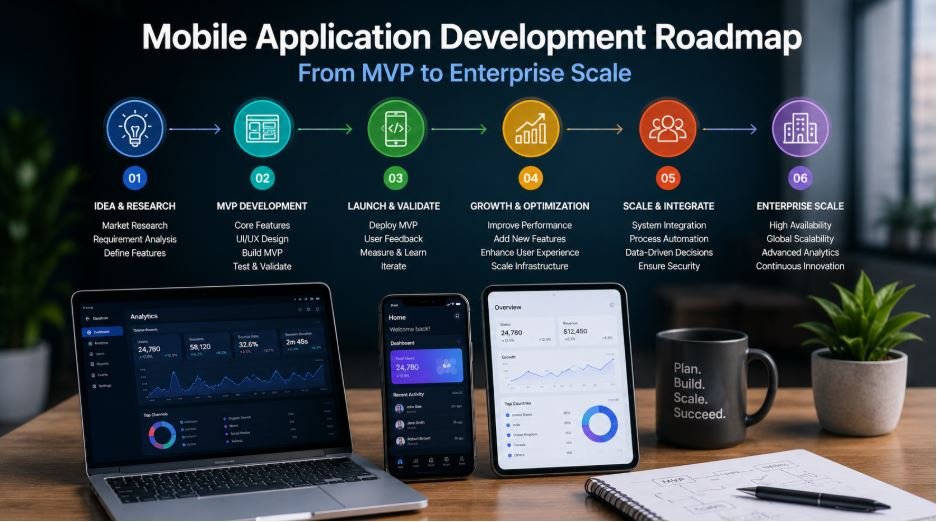
Here’s what the actual roadmap looks like, from the first working version of an idea to something running cleanly at genuine enterprise scale.
Stage One: MVP — The Art of Building Enough and Nothing More
The MVP stage has one job. Find out if real people will actually change their behavior to use this thing. Not whether it’s technically impressive, not whether it has every planned feature, whether the core value proposition works in the real world.
That’s a narrower brief than most founders start with.
The mistake most teams make here isn’t building too little, it’s building too much while still calling it an MVP. Onboarding flows that could wait. Settings screens nobody asked for. Features added because a competitor has them, not because a real user asked for them. Every one of those decisions adds weeks and costs money that should have gone toward finding out if the fundamental idea actually works.
A true MVP is uncomfortably narrow. It does one thing well enough that the right kind of user will tolerate the rough edges to get to that value. If it’s comfortable to show people, it’s probably too polished for the validation stage and not polished enough for real scale.
What the Architecture Decision at This Stage Actually Costs You Later
Here’s the thing nobody fully explains during the MVP conversation. Certain architectural shortcuts that make a build faster and cheaper in month one become expensive technical debt in month eighteen. Choosing a database structure based on what’s quick to implement rather than what’s right for the data model you’ll eventually need. Skipping proper API versioning because it feels premature. Building authentication logic that works fine for two hundred users and breaks awkwardly at twenty thousand.
None of this is catastrophic in isolation. Together, it adds up to a scaling conversation that’s far more expensive than it needed to be — not because the team was incompetent, but because nobody flagged which shortcuts were cheap now and costly later versus which ones were fine to revisit.
A good development partner flags those distinctions early. A bad one just builds what’s asked.
Stage Two: Early Growth — When Validation Becomes Real Load
Something shifts when an app moves from proving the idea to handling real daily users. The codebase that was fine for a controlled launch starts showing its seams under actual usage patterns.
This is the stage where performance issues that never appeared in testing surface in production. Where the database queries that were perfectly fast with a small dataset suddenly crawl when real data accumulates. Where the user flows that felt intuitive to a founding team turn out to confuse a meaningful percentage of real users in ways that analytics make impossible to ignore.
The work in this stage is less about adding features and more about hardening what exists. Monitoring systems that catch problems before users report them. Performance optimization that keeps the experience smooth as load increases. User analytics that reveal where the actual friction points live, not where the team assumed they’d be.
Teams that skip this stage, jumping straight from MVP to feature building without hardening the foundation, tend to discover their neglect at the worst possible time, during a traffic spike or a press mention when new users are forming their first impression of the product.
Stage Three: Scaling the Team, Not Just the Tech
There’s a scaling problem that’s purely technical, and there’s a scaling problem that’s organizational, and they tend to arrive around the same time and get confused for each other.
A codebase that one developer understood completely becomes a codebase that five developers need to navigate without breaking each other’s work. Release processes that were informal when the team was small need actual structure when multiple people are shipping changes simultaneously. Code review, documentation, testing standards — these stop being nice-to-haves and start being the difference between a team that ships confidently and one that’s constantly putting out fires it accidentally started itself.
This is where a lot of fast-growing apps visibly slow down, not because the technology can’t scale, but because the engineering organization around it hasn’t scaled alongside it. Technical leadership that can make architectural decisions under uncertainty, development processes that keep a larger team moving without creating coordination bottlenecks, these are as important as any infrastructure upgrade at this stage.
Stage Four: Enterprise Scale — Different Problems Entirely
Enterprise scale introduces a category of requirements that simply doesn’t exist at earlier stages and can’t really be retrofitted without significant rework if the foundation wasn’t built with them in mind.
Security requirements get serious in ways that are qualitatively different from consumer app security. Compliance requirements show up depending on industry and geography. Integration with existing enterprise systems, the kind that have been running for a decade and weren’t designed with modern APIs in mind, becomes a major workstream. Support for single sign-on, granular permissions, detailed audit logging, multi-tenant architecture — these aren’t features you add, they’re architectural properties that need to be designed for.
The organizations that navigate this stage most smoothly tend to be the ones who made a few key decisions correctly much earlier, keeping the data model clean, building the API layer in a way that could support different client types, avoiding the shortcuts that felt harmless at MVP but would have required painful refactoring at this point.
What the Cost to Build an MVP Actually Tells You
Cost to build an MVP is one of the most searched questions in the startup world and one of the least useful in isolation, because the number means almost nothing without knowing what the MVP is supposed to do and what the path after it looks like.
A lean MVP for a consumer utility app might be built for tens of thousands of dollars with a small experienced team. A healthcare MVP with real data sensitivity requirements, even a lean one, costs considerably more because cutting corners on data handling isn’t actually an option regardless of how early-stage the product is. An enterprise MVP that needs to prove integration capability with existing systems costs more still.
What the number should actually be evaluated against is the cost of the roadmap beyond it. An MVP built cheaply in ways that create expensive technical debt isn’t actually cheap when you account for what it costs to scale. An MVP built with slightly more intention around the architectural decisions that matter at scale is often a better investment even if the upfront number is higher, because the scaling conversation six months later is a different kind of problem.
The Through-Line Across Every Stage
Looking back at apps that successfully navigated this entire roadmap, from rough first version to something running cleanly at real enterprise scale, a few things show up consistently.
The teams that got there didn’t necessarily move the fastest at the MVP stage. They made better decisions about which shortcuts were acceptable and which ones would cost them later. They hardened the foundation before adding the next layer of features instead of deferring that work indefinitely. They scaled the engineering organization deliberately rather than waiting for the coordination problems to become undeniable before addressing them.
And almost universally, they had a development partner who understood which stage of this roadmap they were actually in, and built accordingly rather than applying the same approach regardless of where the product was in its lifecycle.
That last part matters more than it sounds like it should.
